
I used to think community happened naturally. If people lived nearby, worked in the same place, or visited the same stores, I assumed connection would eventually follow. Over time, I noticed that daily life can be surprisingly disconnected. People can share sidewalks, elevators, coffee counters, and waiting rooms without exchanging more than a glance.
I started realizing that community is usually built through smaller moments. A familiar face becomes a greeting, a greeting becomes a conversation, and repeated conversations can eventually create trust. Learning how to build a sense of community in everyday life does not require a packed calendar or a huge social circle. It often begins with making ordinary interactions a little more intentional.
Start With the People Already Around You
The easiest place to begin is where you already spend time. Say hello to a neighbor instead of walking past with your eyes on your phone. Ask a coworker about the weekend. Learn the name of the person who makes your morning coffee. Repeated recognition gives relationships a starting point.
Familiarity has a quiet social effect. When people see each other regularly, conversations usually become easier because there is shared context. You do not have to force a deep discussion. A comment about the weather, a local event, a dog, or a familiar routine can be enough.
That is also why being present matters. Looking up from a screen, making eye contact, and responding when someone speaks creates openings that might otherwise disappear.
Being connected does not mean you have to be around people constantly. Spending time alone without feeling lonely can give you space to recharge, reflect, and return to everyday interactions with more energy.
Turn Everyday Routines Into Social Anchors

Community becomes easier to build when connection is attached to something you already do. Instead of searching for another obligation, look at your existing routine. A regular walk, Saturday farmers market, neighborhood park, gym class, library visit, or coffee stop can become a social anchor.
Going to the same place at roughly the same time creates repeated encounters. You may start recognizing staff, regulars, runners, or dog walkers. Eventually, a simple nod can turn into a conversation, and that conversation can lead to a shared activity.
The key is consistency rather than intensity. Visiting one place every week may create more familiarity than attending five unrelated events once each.
Small routines also make socializing less intimidating. There is already something to talk about because everyone is participating in the same environment.
Create Connection Through Shared Activities
Talking is not the only way to build community. Sometimes doing something together makes connection much easier.
Choose an activity you genuinely enjoy. A cooking class, recreational league, book club, gardening group, neighborhood cleanup, art workshop, or volunteer shift gives people a natural reason to interact. The activity carries part of the conversation, so nobody has to invent a topic from nothing.
Volunteering can be useful because it combines shared purpose with repeated contact. Helping at a food pantry, library, community garden, or local event can introduce you to people who care about something similar.
The same principle works on a smaller scale. Invite neighbors for coffee, organize a casual potluck, or suggest a weekend walk. It does not need elaborate planning. A simple gathering can feel more welcoming than an overly organized event.
Make the First Small Move
One barrier to community is waiting for someone else to initiate. Many people want connection but hesitate because they do not want to seem intrusive. A specific invitation can lower that uncertainty.
Instead of saying, “We should hang out sometime,” try something concrete: “I’m walking at the park Saturday morning if you want to join.” A clear invitation gives the other person an easy yes or no.
Small favors can work similarly. Offering to bring in a neighbor’s trash bin, share garden produce, or pick up mail during a trip creates opportunities for trust. These gestures work because they are practical rather than performative.
Community should not become a contest to be available to everyone. Healthy connection includes boundaries. You can be friendly, helpful, and open while keeping enough space for your own responsibilities and energy.
Let Small Connections Grow
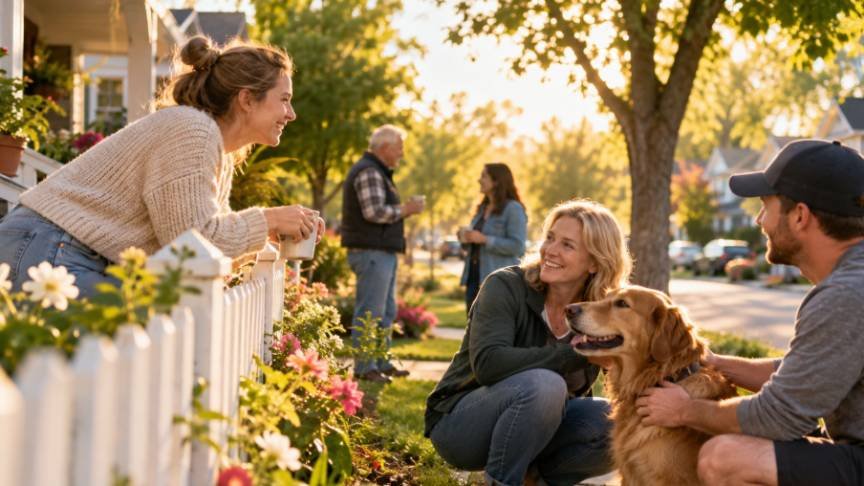
Not every friendly interaction needs to become a friendship. That distinction makes community-building more natural. A person you regularly greet at the gym may never become a close friend, yet seeing that familiar face can still make the place feel more welcoming.
For people who want deeper relationships, small interactions provide the foundation. How to make meaningful friendships as an adult often starts with the same ingredients: repeated contact, shared experiences, genuine curiosity, and follow-through.
Give relationships time to develop. Ask a follow-up question. Remember something someone mentioned. Check in after an event.
Building a positive mindset can also help you approach new connections with more openness and patience, especially when relationships take time to develop.
If a conversation goes well, suggest doing something similar again. These small acts signal that the relationship matters.
Digital tools can help with finding local groups or staying connected after meeting someone. But online contact works best when it supports real relationships rather than becoming the only form of participation.
Frequently Asked Questions
1. How can I build community if I am shy?
Start with predictable, low-pressure interactions. Say hello to neighbors, attend a recurring class, or become a regular at a local place. Familiarity can make conversations easier over time.
2. Do I need to join a community group?
No. Community can grow through neighbors, coworkers, local businesses, shared routines, volunteering, and casual activities. Formal groups are only one option.
3. How long does it take to feel connected?
There is no fixed timeline. Repeated contact, reliability, and shared experiences generally give relationships more opportunities to develop. Even small improvements in familiarity can make a place feel more welcoming.
4. What if people do not respond?
Do not treat every interaction as a test. Some people are busy, private, or simply having an off day. Keep being friendly, try different settings, and let reciprocal relationships develop naturally.
Why Small Connections Have Staying Power
A strong community rarely appears because everyone suddenly decides to become close. It grows through ordinary repetition: the neighbor who recognizes you, the barista who remembers your order, the person you see at the Saturday market, or the volunteer who saves you a seat. These relationships create a sense of being known. Over time, those small points of contact can make daily life feel less anonymous and more connected.
Make room for connection where life already happens locally.