Sitting is not automatically unhealthy. The bigger problem is spending hour after hour barely changing position. Federal physical activity guidance now emphasizes a simple principle: move more and sit less. Long stretches of sedentary time are associated with higher risks of cardiovascular disease, high blood pressure, type 2 diabetes, and premature death. That makes healthy habits for people who sit all day less about buying a standing desk and more about repeatedly interrupting stillness.
For desk workers, drivers, remote employees, gamers, students, and anyone whose day happens mainly in a chair, small movement habits can add up surprisingly quickly.
Why Long, Uninterrupted Sitting Matters
Your body is designed to alternate between positions and levels of activity. When you stay seated for hours, large muscles in your legs and hips remain relatively inactive, energy expenditure falls, and circulation changes.
MedlinePlus, a service of the U.S. National Library of Medicine, notes that an inactive lifestyle can affect how the body handles fats and sugars while contributing to poorer circulation and loss of muscle strength.
The U.S. Physical Activity Guidelines similarly report a strong relationship between greater sedentary behavior and increased risk of cardiovascular disease, hypertension, and all-cause mortality.
Importantly, the government does not specify a universal maximum number of sitting hours. Your age, activity level, health, occupation, and total exercise matter.
The practical message is simpler: avoid making sitting one continuous block.
For people whose work keeps them seated for much of the day, the solution is often to build healthier behaviors into the existing workday rather than attempt a complete lifestyle overhaul. Exploring healthy habits for office workers can help turn movement, posture, breaks, hydration, and other practical behaviors into manageable parts of a normal working routine.
Make Movement Interruptions Your First Line of Defense

A 45-minute workout after work is valuable, but it does not mean the other eight hours should be motionless.
Think of movement as something sprinkled throughout your day rather than something reserved exclusively for the gym.
A useful starting pattern is to stand or move every 30 to 60 minutes. Walk to refill your water, climb a flight of stairs, perform several chair squats, or pace during a phone call.
Research summarized by Harvard Health found that, in a small controlled study of 11 adults, five minutes of light walking every 30 minutes improved both blood sugar and blood pressure compared with uninterrupted sitting. The study was small, so it should not be interpreted as a universal prescription, but it illustrates why frequent movement matters.
Try the 50-5 Workday Rule
If alarms every 30 minutes become distracting, use a simpler rhythm:
| After roughly this much sitting | Do this |
| 50 minutes | Stand and walk for 3–5 minutes |
| 2–3 hours | Take a longer 10-minute movement break |
| Lunch | Walk before or after eating when possible |
| End of workday | Add purposeful exercise or a longer walk |
You do not need to perform intense exercise during these breaks. Light activity still replaces sedentary time with movement.
Fix the Desk Before Blaming Your Back
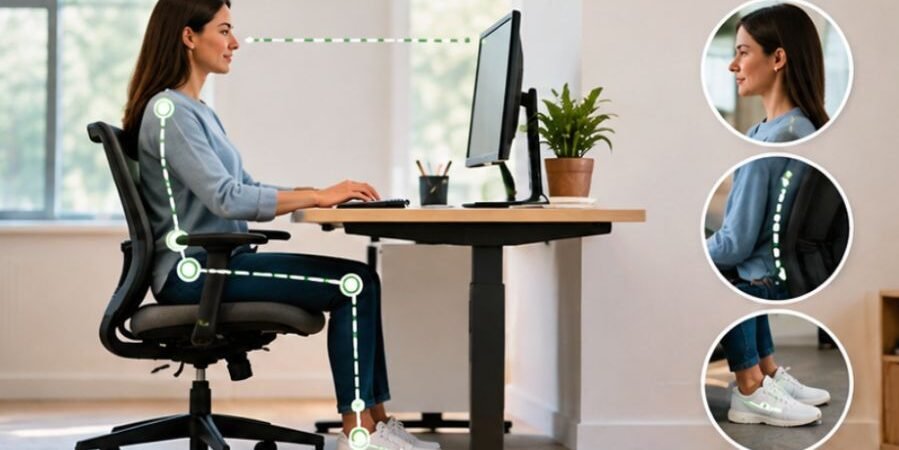
Perfect posture does not exist, and holding any single posture for hours can become uncomfortable. A well-arranged workstation nevertheless reduces unnecessary strain.
OSHA’s computer-workstation guidance recommends keeping the head and neck aligned with the torso, shoulders relaxed, elbows close to the body, lower back supported, wrists aligned with the forearms, and feet supported.
Instead of obsessing over an exact 90-90-90 pose, aim for a neutral, relaxed setup.
Run This 60-Second Ergonomic Test
Sit where you normally work and check:
Can your feet rest flat on the floor or on a stable footrest?
Does the chair support your lower back?
Can you reach your keyboard and mouse without leaning forward?
Are your shoulders relaxed rather than raised?
Is your monitor directly in front of you?
OSHA recommends placing the top of the monitor at or slightly below eye level and generally keeping it about 20 to 40 inches from your eyes. Cornell University’s ergonomics guidance likewise emphasizes a centered monitor, neutral wrists, relaxed arms, back support, and supported feet.
A rolled towel behind the lower back can serve as temporary lumbar support if your chair lacks it.
Stretch What Sitting Keeps Short and Wake Up What It Ignores

Stretching will not erase the health effects of inactivity, but it can help address stiffness caused by staying in one position.
Start with your hip flexors. Sitting keeps the hips bent for long periods, so a gentle standing or half-kneeling hip-flexor stretch can feel particularly useful after desk work.
Next, open the chest. Bring your arms behind you, gently draw your shoulders back, and lift through the chest without forcing your lower back.
Then give your glutes something to do. Bodyweight squats, glute bridges, stair climbing, and walking all recruit muscles that spend much of a desk day relatively inactive.
Even one or two minutes can be enough to change position and create a movement break.
Walking Calls May Be More Useful Than Another Productivity Hack
Some of the easiest activity comes from redesigning tasks you already perform.
Take audio-only meetings while standing. Walk while calling family. Use a restroom farther from your desk. Park slightly farther from the entrance. Carry groceries rather than automatically using a cart for a tiny purchase.
These habits work because they do not require finding an entirely new block of time.
There may also be a psychological benefit to breaking a mentally stagnant work period. A short outdoor walk can separate one task from the next, and deliberately noticing pleasant details along the way can complement practices that train your brain to see the good.
A Standing Desk Helps, but It Is Not a Cure
Standing desks are frequently treated as the solution to prolonged sitting. They are better viewed as a tool for changing position.
Standing motionless for hours can create its own discomfort. The goal is variation: sit, stand, walk, stretch, and return to the position appropriate for the task.
The American Heart Association continues to encourage people to reduce prolonged sedentary time and incorporate accessible activities such as walking.
Adults should also work toward the federal recommendation of at least 150–300 minutes of moderate-intensity aerobic excercises per week plus muscle-strengthening activity on at least two days.
Movement breaks complement those targets; they do not replace them.
Build a Day That Makes Movement Automatic

One of the most reliable healthy habits for people who sit all day is attaching movement to events rather than relying on memory. Stand after sending a major report. Walk after lunch. Stretch whenever coffee brews. Do squats before your afternoon meeting. Pace during calls that do not require a screen.
Environmental cues help too. Keep water away from the desk so refills require walking. Put your printer across the room. Leave resistance bands where you can see them. The best system creates reasons to move before stiffness reminds you.
The same principle can be applied to other behaviors you want to change: make the healthier response easier to access and the unwanted response less convenient. Learning how to replace bad habits with healthier ones involves identifying the cues behind an automatic behavior, changing the environment around those cues, and creating a practical alternative that is easy to repeat.
When General Advice Is Not Enough
Persistent pain, numbness, weakness, swelling, dizziness, or tingling should not simply be blamed on desk work. Those symptoms can have many causes and deserve evaluation by a qualified healthcare professional.
People recovering from surgery, managing heart or joint conditions, living with mobility limitations, or returning to exercise after a long inactive period may also need individualized guidance.
Movement should be adapted to your abilities rather than forced into a standard routine.
Frequently Asked Questions
1. How often should I get up if I sit all day?
A practical goal is movement every 30–60 minutes. Even a few minutes of walking, standing, or gentle mobility can interrupt long sedentary periods.
2. Can exercising once a day compensate for sitting at work?
Regular exercise greatly benefits health, but frequent movement still matters. Try to combine recommended weekly exercise with fewer long, uninterrupted periods of sitting.
3. Are standing desks healthier than sitting desks?
They can help you change positions, but standing still is not the same as physical activity. Alternating sitting, standing, and walking is usually more useful.
4. What are the easiest healthy habits for people who sit all day?
Start with walking breaks, standing during calls, proper workstation setup, supported feet, hip and chest stretches, and regular strength and aerobic exercise.
Make Sitting Something You Interrupt
The most useful change is not an expensive chair, elaborate stretching routine, or perfect posture. It is refusing to let stillness run uninterrupted through your entire day.
Start with one trigger: every time you finish an hour of work, stand up and move for several minutes. Once that becomes automatic, add walking calls, better desk positioning, strength training, and longer activity.
A desk job may determine where you work, but it does not have to determine how little you move. The healthiest workday is rarely one spent entirely standing or sitting—it is one where your body keeps getting opportunities to change.